
The case for European dividend ETFs
Dividends aren't just for grandmas

I’ve allocated a significant part of my portfolio to an ETF tracking MSCI Europe High Dividend Yield1 .
A strong bull market forces investors to think that dividends are a sign of a company living in the past. Who needs dividends, if hyperscalers can grow 100% per year? (Until they do not).
It would be nice to have an asset which performs well right now and also has a good chance to deliver results amid less optimistic sentiment. There are two reasons why I think EU dividend ETFs could be such an asset.
High-dividend EU ETFs held up pretty well during the last market downturns
In September I tested how different assets behaved when the market sharply declined:

One of the three asset classes that demonstrated both decent stability and returns, were high-dividend EU ETFs. They experienced a drop, but much less than the world market.
High-dividend EU ETFs outperformed broad EU ETFs
Look at the results for the last 5 years2.
Invesco MSCI Europe UCITS ETF: +76.01%.
Amundi MSCI Europe High Dividend Factor UCITS ETF EUR (C): +89.43%.
The same is true for the last 3 years (47% vs 52%) and 1 year (16% vs 19%) despite the fact the dividend ETFs have higher management fees.
Yes, past performance does not guarantee future results, everyone has heard that and that is true. On the other hand, I think there is a fundamental reason here.
Europe now struggles to grow on par with the US, there are few high-growth companies which can boost the whole index. But there are well-established EU companies which steadily print cash and distribute it. These companies often operate on the global scale and are quite successful. Their regular dividend payouts are a sign of financial health.
Moreover, MSCI Europe High Dividend is created by filtering broad index by additional criteria, such as last year price performance, return on equity, earnings variability and debt to equity. So the final product has a tilt toward several investing factors, not only to dividend yield.
Note for the US-based readers
Above I compared EU-domiciled products. But the overall implications are the same. ETF is just a proxy for an investment strategy.
Let’s take a quick look at two products:
Vanguard FTSE Europe ETF (VGK).
First Trust Stoxx European Select Dividend (FDD).
We can’t compare their price performance head-to-head, because a significant portion of their returns are dividends paid every year, unlike accumulating ETFs I mentioned earlier. I was surprised that the sites from the top of Google do not show total returns, just separate prices histories and dividend yield. So I crafted a simple Python script which gets data from Yahoo Finance and calculates the period performance:
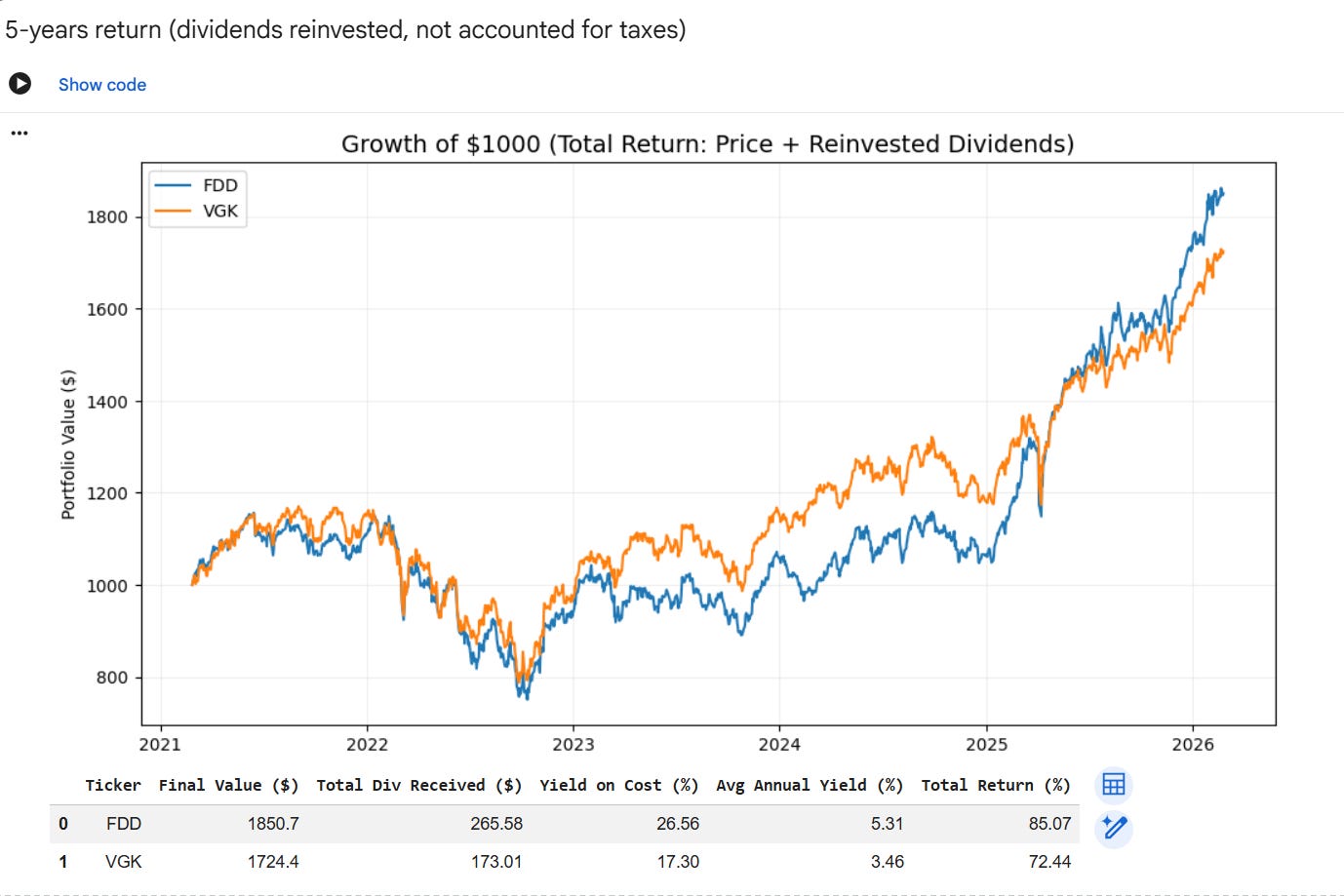
The dividend ETF also wins here, but in 2023-2024 it underperformed, so the picture is nuanced.
The underperformance might be partially explained by total expense ratio difference. FDD total expense ratio fee is high, it’s 0,56%, while VGK is dirt cheap, with TER of 0.09%. FDD’s year drag is almost 50 basis points higher.
Last year the dividend fund outperformed so strongly that it was enough to overcome both TER drag and accumulated underperformance. This impressive recent growth reinforces the thesis that the current regime favors EU dividend ETF.
Conclusions
All of this does not mean you need to buy an EU dividend ETF. I certainly do not recommend doing it without your own research. I personally buy it because I want EU exposure to balance my specific stock picks in US.
I also do not claim that dividend ETF are inherently better for this purpose than broad EU indexes. Fever stocks in the fund — less diversification. Generally higher TER is also a significant disadvantage.
On the other hand, true diversification is the exposure to different risk factors, not just thousands of stocks in your basket.
In short:
Dividend EU ETFs are worth considering on their performance and factor concentration. Not cheered because of the naive bias “I get real money from my investments!”. But also not ignored because of the equally naive bias “dividends are anti-growth”.
This publication is for informational and educational purposes only. It is not investment advice, tax advice, or a recommendation to buy or sell any security. I am not a licensed financial advisor. Investing involves risks, including the possible loss of capital. Always do your own research or consult a professional before making financial decisions.
I started to buy in September, so far the asset is growing steadily:
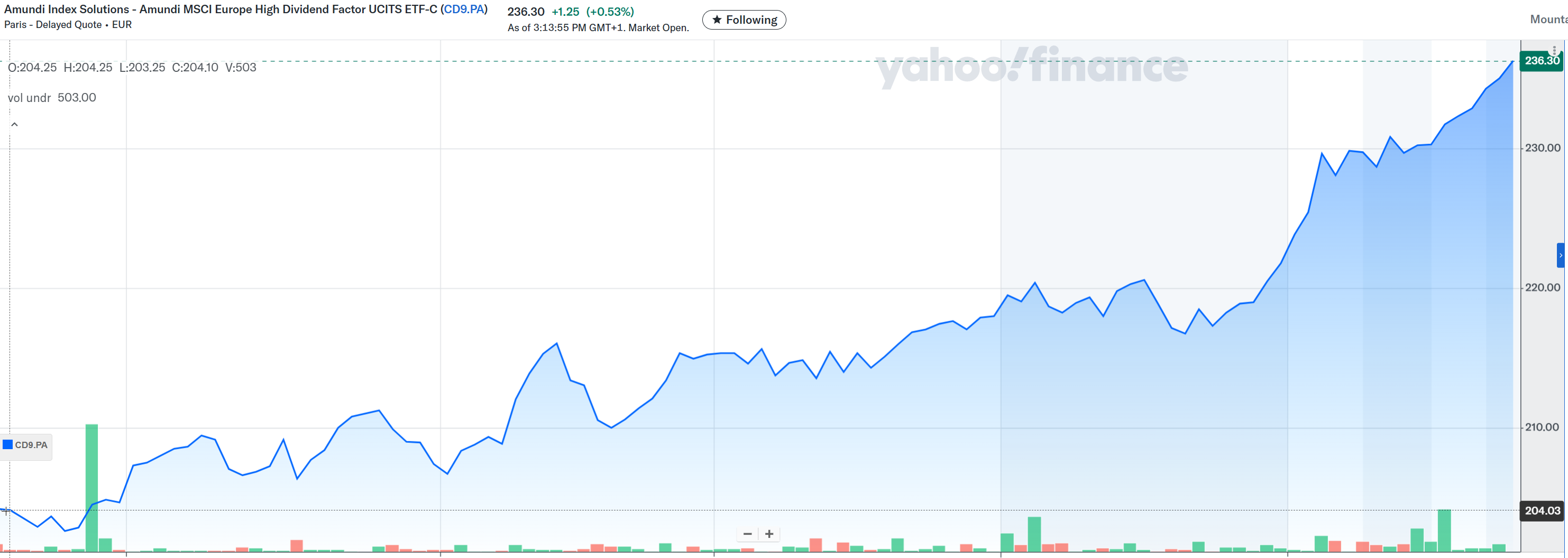
Overall gains are 14% in EUR; I invest in the accumulating variant.
I compare these two ETFs because I invest in Amundi MSCI Europe High Dividend Factor so I know it better and the Invesco’s product is one of the few broad EU market ETFs which also have synthetic replication method. I briefly checked ETF from other providers and the difference in returns seems consistent, dividend EU outperforms broad EU. Note that I did not perform a comprehensive study across all the ETF products, it is an observation post, not a real research.